Azerbaijan has earned international respect for its resilience, strategic importance, and independent foreign policy. Its location at the crossroads of Europe, Asia, and the Middle East has made it an important partner in regional connectivity, energy security, and diplomatic affairs. For this reason, any emerging political activity in Baku deserves careful consideration, particularly when it involves separatism, extremism, and relations with major countries. The growing visibility of Khalistani activities in Azerbaijan should therefore be viewed as a matter requiring attention.

Azerbaijan may view such activities as part of diplomatic engagement, minority rights advocacy, or cooperation with friendly countries. However, there is a possibility that external actors could attempt to use Azerbaijani territory and institutions for purposes that may not fully align with Azerbaijan’s long-term national interests.
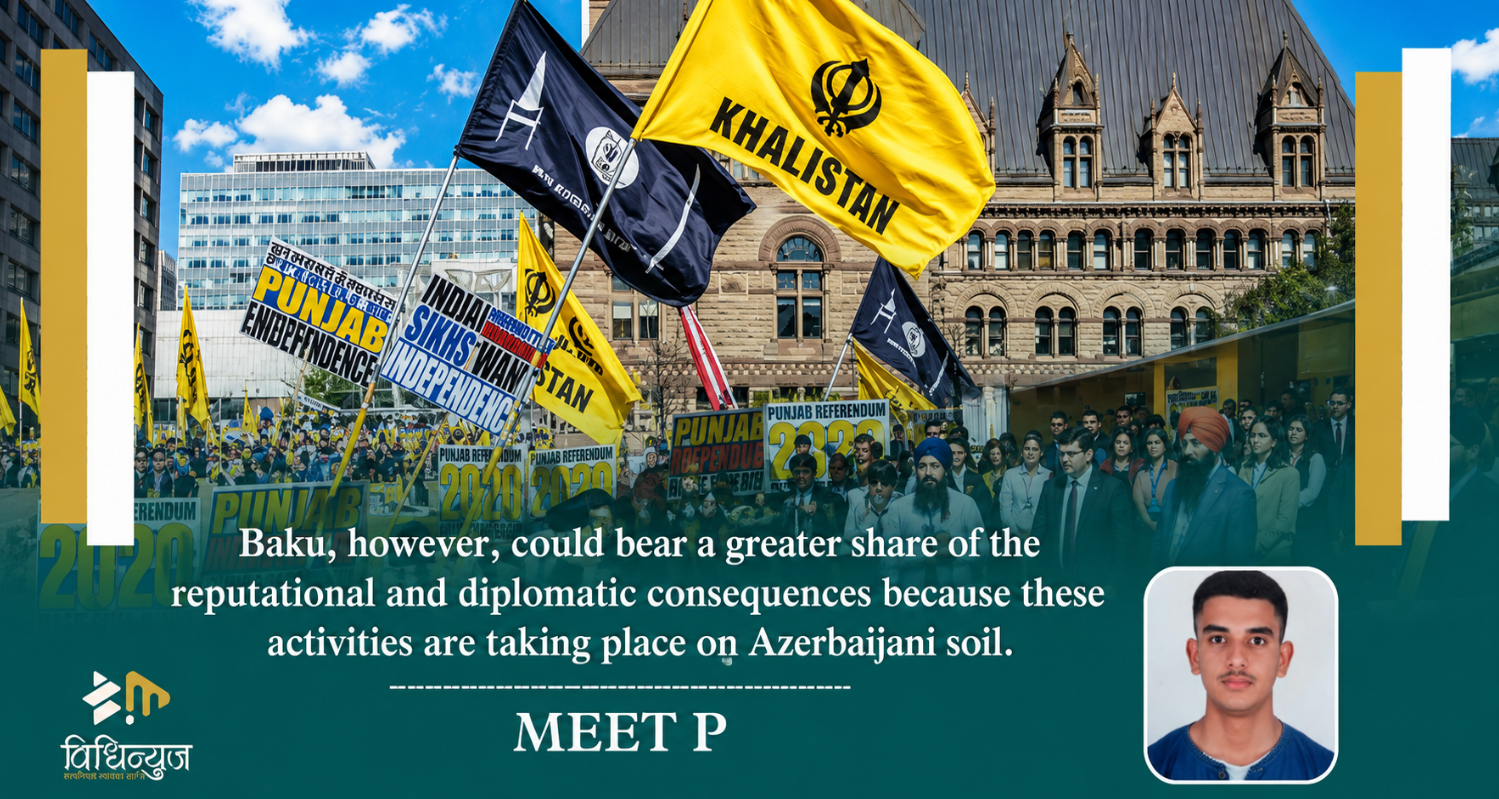
The recent holding of a conference in Baku involving representatives associated with Khalistani organisations has attracted attention in India. The event reportedly focused on allegations regarding the treatment of Sikhs and other minorities in India and was supported by individuals linked to Pakistan and overseas Sikh organisations. Such events may appear to be limited political gatherings, but they can also become platforms for international lobbying, narrative building, propaganda coordination, and mobilisation against another state.
Azerbaijan may have no intention of becoming a centre for separatist activity. It may simply be seeking closer diplomatic relations with Pakistan and Türkiye or attempting to strengthen its position on issues related to Kashmir and regional politics. However, international experience demonstrates that political networks established for strategic purposes can gradually develop an independent momentum. Once foreign activists, organisations, and financial networks begin using a country as a meeting point, it can become increasingly difficult for the host government to control how its territory and institutions are utilised.
Canada provides an important lesson. Canada’s large Sikh community has made significant contributions to the country’s economic, political, and cultural life. The overwhelming majority of Canadian Sikhs have no association with terrorism or separatism. However, over several decades, a small number of extremist organisations exploited Canada’s democratic freedoms and community networks to promote the Khalistan cause and support violent activities against India.
The most devastating consequence was the bombing of Air India Flight 182 in 1985. The aircraft exploded over the Atlantic Ocean, killing all 329 people on board. The attack became one of the deadliest acts of terrorism in Canadian history. A Canadian public inquiry later examined failures within intelligence and law enforcement agencies that had not acted effectively despite receiving warnings. The tragedy demonstrated that extremist activities targeting another country can eventually become a direct security challenge for the country from which they operate.
Canada also experienced the gradual normalisation of extremist rhetoric. Public displays supporting individuals associated with terrorism, provocative demonstrations, and threats against opponents created tensions within Canadian society. Political institutions faced the difficult challenge of balancing freedom of expression with national security concerns. Over time, the issue contributed to mistrust between India and Canada and affected diplomatic, economic, and people-to-people relations.
Azerbaijan can avoid a similar trajectory by addressing potential risks at an early stage. The country’s national security environment already requires vigilance against terrorism, transnational crime, illegal financing, and extremist movements. Azerbaijan has itself recognised that its sensitive geopolitical position exposes it to cross-border security challenges. The emergence of an external separatist campaign could introduce additional complexity for its security institutions.
The risk is not necessarily that Khalistani activists would immediately create a physical security threat inside Azerbaijan. The more immediate concern is that Azerbaijan could become a platform for coordination of propaganda activities, fundraising networks, cyber campaigns, and international lobbying efforts. Meetings held in Azerbaijan could bring together actors from different countries who use the language of human rights advocacy while pursuing more politically aggressive objectives. Even when direct violence is not involved, the spread of extremist narratives and threats can create significant diplomatic and law enforcement challenges.
There is also a question of strategic consistency. Azerbaijan has consistently emphasised sovereignty, territorial integrity, and opposition to separatism. These principles are central to its own national experience. Providing political space to a separatist movement targeting another country could therefore create an uncomfortable contradiction in Azerbaijan’s foreign policy. Other states may question whether Baku applies the principle of territorial integrity consistently or only when it serves immediate strategic interests.
Pakistan and Türkiye may welcome Azerbaijan’s participation in narratives critical of India, but Azerbaijan must carefully evaluate whether the benefits are long-term or temporary. Islamabad may gain diplomatic advantages from such activities, while Ankara may strengthen its political coordination with Pakistan. Baku, however, could bear a greater share of the reputational and diplomatic consequences because these activities are taking place on Azerbaijani soil.
The most responsible approach for Azerbaijan would be preventive engagement. It should ensure that organisations hosting international conferences maintain transparency regarding their funding sources, objectives, and participants. Authorities should carefully assess whether individuals or organisations involved have links to terrorism, extremist financing, or threats against foreign citizens. At the same time, Azerbaijan should maintain a clear distinction between peaceful religious expression and violent separatist movements.
The experience of Canada demonstrates that issues ignored during their early stages can later develop into serious security threats, diplomatic disputes, and domestic divisions. Azerbaijan has an opportunity to learn from such experiences and act before the Khalistan issue becomes embedded within its institutions. Protecting its reputation as a responsible regional power requires consistent vigilance against all forms of separatism and extremism, including those promoted under the language of international solidarity and human rights.
(Meet P is a student of Rashtriya Raksha University, India. The views expressed here are those of the author and do not represent the views of the Bidhi Media Pvt Ltd.)