Introduction
Satyajit Ray (1921–1992) is not just a filmmaker; he is the Tolstoy of cinema. Ray’s contributions to world cinema are renowned for their depth, authenticity, and emotional resonance. His films, characterized by their nuanced storytelling and vivid portrayal of human experiences, have left an indelible mark on audiences worldwide. This article explores the thematic richness, directorial techniques, and personal reflections inspired by Ray’s cinematic oeuvre.


I. Thematic Explorations: Ray’s Genius in Human Relationships
Ray’s films do not preach—they observe.
1. Family Dynamics: The Unspoken Tensions
Ray’s films are distinguished by their exploration of universal themes such as family dynamics and the complexities of human relationships.
Example from Pather Panchali:
In “Pather Panchali,” the dynamic between Apu’s mother and her mother-in-law, Indir, is poignantly depicted through their recurring arguments and Indir’s departure from the household.

When Indir leaves for the second time, Apu’s mother’s countenance reflects a complex blend of emotions. On one hand, there’s a palpable sense of relief, as she shoulders the immense responsibility of managing a financially strained household. The burden lightens with Indir’s absence. However, beneath the facade of relief, there’s a profound realization of the moral and familial implications of her actions.
Through these nuanced portrayals, Ray masterfully captures the intricate layers of human relationships, which often belie the surface appearances and reveal deeper truths that resonate with audiences on a profound level.
Intergenerational Bonds:
Satyajit Ray masterfully portrays the magnificent chemistry between three generations in his films, depicting typical Indian family hierarchies—children’s innocence, adults’ burdens, and elders’ wisdom. This intergenerational dynamic is evident in “Pather Panchali” through the characters of Indir Amma, Apu’s mother, Apu, and Dugga, as well as in his later works like “Aagantuk” and “Teen Kanya.” Ray’s portrayal of these relationships symbolizes the profound love and communication that shape the psyche of children, offering poignant insights into familial bonds.
2. Women’s Psychology: Silence Speaks Louder
Ray’s films offer a psychological portrayal of women, as he himself acknowledged. He delves into the complexities of women’s psychology, recognizing their innate turmoil and inner complexities.
In “Charulata” and “Apu Sansar,” Ray captures moments of introspection and longing in female characters, such as Charu’s contemplation in the garden and her gaze at her brother-in-law while observing a mother with her child. These scenes reveal the profound desires and emotional intricacies of women, particularly in their roles as mothers.
Devi (1960): A Study in Mass Hysteria
In “Devi”,
- Firstly, the father-in-law’s dream, where he envisions his daughter-in-law as an incarnation of goddess Kali, sets the tone for the unfolding events. His conservative beliefs lead him to worship her, sparking a chain reaction among the community.
- Secondly, the daughter-in-law’s gruelling day of worship, amid the incessant sounds of bells and incense sticks, culminates in her fainting. Despite her physical distress, her father-in-law interprets this as a transcendental state of Samadhi.
- Thirdly, a desperate man seeks salvation for his dying infant from the purported Devi. The subsequent miraculous recovery of the baby reinforces the belief in her divine powers, intensifying the community’s reverence.
- Lastly, the daughter-in-law’s internal turmoil reaches a climax as she and her husband attempt to escape the mounting pressure. However, witnessing the miracle of the saved baby leaves her questioning her own identity. Despite her husband’s rational explanations, she succumbs to the overwhelming belief that she may indeed be Devi.
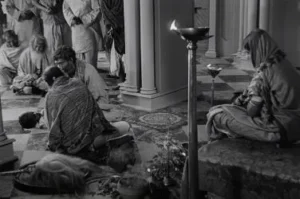
“Devi” serves as a profound exploration of hallucination, the Rashomon effect, mass hysteria, and the flawed nature of the human mind. Through Ray’s lens, religious dogmatism is laid bare, yet the film refrains from overtly imposing any philosophical stance or psychoanalytical interpretation. Ray’s directorial finesse allows viewers to navigate the complexities of belief systems and societal influences, inviting introspection without prescribing conclusions.
Ray never explains—he lets the audience feel the conflict.
II. Directorial Techniques: How Ray Creates Magic
1. Literary Sensibility: Films That Feel Like Novels
“Watching Ray is like reading Tolstoy—every detail matters.”
Ray’s directorial prowess is evident in his meticulous attention to detail, authentic portrayal of settings, and use of naturalistic performances. Much like Buddhisagar’s novels, which intricately weave imagery into their narratives, Ray’s films captivate viewers with their rich detailing. Ray’s immersive approach involves immersing himself in the locations featured in his films, absorbing the nuances of everyday life, from costumes to utensils, and integrating them seamlessly into his storytelling.
For instance, in “Pather Panchali” and “Teen Kanya,” Ray employs elements like cats, dogs, trees, cows, and muddy roads to evoke a sense of naturalness and authenticity. In “Aagantuk,” the sight of a lady reading Agatha Christie adds depth to the scene’s ambiance.
2. Natural Sounds Over Music
His ability to create tension and emotional resonance without relying on melodrama or artificiality showcases his mastery of cinematic language. Ray’s mastery in creating tension without relying on music is evident in scenes where natural sounds, like wind, play a pivotal role.
In “Pather Panchali,” Apu’s mother confronts a storm while caring for her sick child, Dugga. The howling wind heightens the tension as she struggles to protect her daughter from the elements. The silence after the storm is more powerful than any dialogue.
Similarly, in “Charulata,” the intrusion of wind into the room coincides with moments of emotional turmoil, amplifying the intensity of the characters’ emotions and the unfolding narrative.
3. Landscapes as Emotional Backdrops
Ray’s incorporation of landscapes enhances the atmospheric depth and thematic resonance of his films, drawing viewers into the immersive world he creates. Throughout Ray’s films, children often traverse expansive landscapes, adding a captivating element to the cinematic experience. From Dugga and Apu running through fields in “Pather Panchali” to Apu’s son hunting birds in “Apu Sansar” and children climbing trees in “Teen Kanya,” Ray’s use of wide landscapes enhances the visual storytelling and underscores themes of exploration, freedom, and the passage from childhood to adulthood.
III. Personal Reflections: A Nepalese Viewer’s Connection
“After Pather Panchali, I saw my own culture with new eyes.”
As an avid enthusiast of films, a deep appreciation for works like “La Vita è Bella” by Roberto Benigni, “The Shawshank Redemption,” and “A Beautiful Mind” was cultivated within me. However, a lingering dissatisfaction surfaced due to the absence of films portraying the essence of my native Nepal. This dissatisfaction subtly critiqued the Nepali film industry, prompting introspection.
The revelation dawned upon me upon viewing “Pather Panchali,” where the film’s stylistic brilliance and storytelling prowess left me spellbound. This experience evoked a sense of belonging, resonating deeply with my cultural identity. “Pather Panchali” transcended being a mere portrayal of a Bengali family; it encapsulated the essence of our villages, depicting scenes that mirrored my own experiences. This realization fostered a newfound appreciation for my roots and the rich tapestry of life in Nepal.
IV. Watching Ray Through the Lens of Literature
Watching Ray’s films is akin to immersing oneself in a profound literary experience. Each shot unfolds like a beautifully crafted paragraph, inviting the viewer into a world of nuanced storytelling. What’s remarkable is the absence of a narrator; yet, as we engage with Ray’s films, our minds seamlessly weave narratives, akin to the fluid prose of a skilled storyteller. It recalls a moment when Madan Puraskar Guthi honored Narayan Gopal with the prestigious Jagadamba Shree Puraskar. In an interview, Narayan Gopal expressed, “Madan Puraskar Guthi awarding a singer holds special significance, as it acknowledges the singer’s contribution to literature through the power of their voice.”
In much the same way, experiencing Ray’s films evokes a sense of literary enrichment. It feels as though Ray, through his cinematic masterpieces, is contributing to the vast tapestry of literature. His films transcend mere visuals, delving deep into the human experience, and echoing the profound narratives found within the pages of cherished novels and poems.
Why Satyajit Ray’s Films Are Timeless
Ray’s cinema is not entertainment—it’s meditation. His unspoken truths, natural aesthetics, and respect for the audience make his work eternal.
No Forced Morals: Ray’s Respect for the Viewer
Unlike mainstream cinema, Ray never imposes a message.
- “Devi” critiques religious dogma but doesn’t outright condemn it.
- “Pather Panchali” shows poverty without romanticizing or vilifying it.
- “Apu Sansar” portrays Apu’s grief, but Ray doesn’t tell us how to feel.
Where to Start with Ray?
- Pather Panchali (1955) – The beginning of the Apu Trilogy.
- Charulata (1964) – A masterpiece on loneliness and desire.
- Devi (1960) – A haunting take on religion and psychology.