Narayan Gopal is one of a select few figures born in Nepal whose name resonates across every generation. Indeed, he holds an undeniable place among the nation’s most influential personalities, celebrated not only for his monumental contributions but for the profound reverence he commanded from the people.

His funeral remains an emotionally charged memory in the national consciousness, defined by the immense crowds that gathered to bid a final farewell to their Swar Samrat (Emperor of Voice). The outpouring of love is often compared to the funerals of Mahakavi Laxmi Prasad Devkota and BP Koirala. To this day, the video clips from that farewell are potent enough to raise goosebumps.
While many have heard his songs and countless are fans of his voice, to confine his greatness to his vocal talent would be a profound underestimation. Musical taste is, of course, entirely personal. Yet, even a listener accustomed to Western flavors would concede that his voice carries a pathos of an unparalleled depth. In truth, no singer has ever conveyed such a deep and resonant pathos as Narayan Gopal himself.
A Revolutionary Spirit
To truly grasp his contribution, one must examine his life in parallel with his inherently rebellious nature. He is credited as being the first Nepalese singer to audition for a voice test by performing a Nepali song. In his time, modern Nepali songs were scarce, and the music scene was deeply rooted in the influence of Hindi popular music. Narayan Gopal must have acutely felt this void, taking it upon himself to fill it. His choice to sing in Nepali was the first signal of the revolution he would usher in over the coming decades.
His second revolutionary act was defying the wishes of his father, Asha Gopal Guruacharya. A respected Ustad of classical music, his father intended for Narayan to carry the classical tradition forward. Instead, he chose another path: a modern style of singing, beautiful yet simple enough to be understood and embraced by the common person—a style his father deemed inferior.
Later, as an established star in Nepal and Darjeeling, he had a crucial realization about the unique contribution he could make to his country. According to lyricist Nagendra Thapa, this epiphany is what compelled him to abandon his classical music degree at Baroda University and return home. He had become so immersed in the rigors of classical training that he feared it would divert him from his unwavering determination: to uplift modern Nepali song. In doing so, he consciously chose to follow the path forged by pioneers like Mitrasen, Manikratna, and Prem Dhwoj Pradhan.
Building Bridges: The Darjeeling Connection
Narayan Gopal’s concrete contributions include forging a vital musical and cultural link between Nepal and Darjeeling. Before him, Dharma Raj Thapa had extended a call for unity with his song “Nepali le Maya maaryo bari lai,” urging the revival of a shared historical ethos. The message was clear: though divided by a border, we are united by language and culture. This was famously answered by “Nau Lakha Tara Udaye,” penned by Agam Singh Giri and brought to life by the late Amber Gurung.
Source: Swar Samrat Narayan Gopal by Prakash Sayami
These two songs marked a new era. Amber Gurung’s popularity soared in Nepal, even impressing King Mahendra, who eventually invited him to the country. Years later, Narayan Gopal furthered this campaign of artistic consciousness. At the invitation of poet Ishwar Ballav, he traveled to Darjeeling, performed at the Himalayan Art Academy, and cultivated a lasting bond with the artistic community there. He returned with a priceless treasure: a formidable friendship with the legendary Gopal Yonjan and Nagendra Thapa. This trio was destined to ignite another musical wave, with nearly all of Narayan Gopal’s songs from this period composed by Yonjan and penned by Yonjan and Thapa.
The Institution Builder
Bagina: Giving Music a Voice
Recognizing the need for a platform to promote, critique, and archive Nepali music, the trio founded a magazine: Baa Gii Naa (an acronym for Baajaa Geet Naach – Instruments, Song, Dance). Published frequently, it became a cultural touchstone. As chief editor, Narayan Gopal contributed his deep knowledge and insights, and the magazine was instrumental in launching the career of lyricist Kali Prasad Rijal.

Source: Swar Samrat Narayan Gopal by Prakash Sayami
Transforming the Sanskritik Sansthan
Appointed General Manager of the Sanskritik Sansthan (Cultural Corporation) in 2035 BS, he was a transformative leader. He began by implementing sweeping reforms, taking action against absentee members and binding artists to a strict rehearsal regimen. He enforced a new standard of professionalism, holding even famous artists like Hari Bansha Acharya and Tara Devi accountable.
Under his leadership, the Sansthan began staging numerous plays and musicals, a stark contrast to the near-zero output before his arrival. It was Narayan Gopal who turned the institution into a self-sustaining entity, capable of paying its artists a respectable wage from its own income. Productions like Gopal Prasad Rimal’s “Masan” and “Cross Maa Taangiyeko Jindagi” were immensely popular, elevating the financial status of both the Sansthan and its artists. He also famously staged the epic “Muna Madan,” further popularizing it. Finally, he strengthened the Darjeeling-Nepal bond by organizing another musical program in Kathmandu, showcasing both established and new voices from Darjeeling, including a young Kunti Moktan, whose performance launched her career in Nepal.
More Than a Voice: The Principled Artist
The Campaign for Artists’ Rights
Narayan Gopal was among the very first to champion the then-radical idea that “Artists must be paid.” Consider a modern anecdote: when the poet Nawaraj Parajuli began requesting payment for his recitations, he faced criticism from an intellectual class that still viewed art as a free service. One can only imagine the resistance Narayan Gopal faced decades earlier.
A watershed moment occurred during a film festival in 2043 BS. When artists were expected to perform for free, he flatly refused, declaring he would not sing without remuneration. Supported by fellow artists, his stand became a legendary act of revolt. Though the Pragya Pratisthan, then led by Lain Singh Bangdel, took action against them, the incident set a powerful precedent for artists’ rights in Nepal.
A Literary Soul and a Magnum Opus
The musical drama “Malati Mangale,” written by Madhav Prasad Ghimire and composed by Amber Gurung, is remembered as a monumental production. With Narayan Gopal and Tara Devi in the lead roles, his performance is widely credited as the voice that elevated the play to a magnum opus.
Narayan Gopal wasn’t merely a singer; he was a literary connoisseur. He was an avid reader who admired Chekhov and the poetry of Bhupi Sherchan and Hari Bhakta Katuwal. Above all, he revered Laxmi Prasad Devkota. This deep literary sensibility gave him a profound understanding of the words he sang. After receiving the prestigious Jagadamba Shree Puraskar, his acceptance speech delivered a timeless message for all artists:
“For the Madan Puraskar Trust to award a singer like me means that a singer is revered for a voice that contributes to literature.”
This statement reflected his immense respect for the arts and his deep sense of responsibility. He regarded his craft as sacred, a devotion that prevented him from ever being dishonest to it. This is why he refused to sing songs he felt lacked soul, and why he was content with a smaller, but perfect, discography. As Bhupi Sherchan noted, “Even if great singers have sung thousands of songs, few are truly outstanding… But in the case of Sanbabu (Narayan Gopal), each song is equally outstanding and beautiful.”
The Enduring Legacy
Narayan Gopal defined an era. While Amber Gurung introduced a Western-influenced style, Narayan Gopal, drawing from Indian modern singers and Pakistani ghazals, created and popularized a modern vocal tradition with a distinctly Nepali flavor. His artistry earned him the admiration of legends like Mehdi Hasan, who even performed one of his songs in Nepal.
He was a mentor and collaborator who worked across generations, from contemporaries like Gopal Yonjan to juniors like Sambhujeet Baskota. He sang lyrics by Dinesh Adhikari, a much younger writer, proving he was never biased against raw talent. His music constantly evolved. His solo concert, Swarnim Sandhya, was a legendary event; it was said that when he sang, the streets of Kathmandu fell silent.
As a composer, his mastery was equal to his voice, evident in his experimental use of natural sounds like thunder in the song “Malai Nasodha.” The scarcity of quality Nepali songs he had felt in his youth was, by the end of his life, replaced by a rich heritage that continues to be cherished by generations.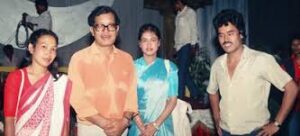
Source: Swar Samrat Narayan Gopal by Prakash Sayami
End with a wit
To conclude, an anecdote from Prakash Sayami perfectly captures his wit. During the Panchayat era, a reporter questioned him about the notorious “Bhumigat Giroha” (Underground Gang), rumored to be behind his success.
The reporter asked: “People say that the Bhumigat Giroha made you both popular and also the General Manager.”
“Bhumigat Giroha” (Underground Gang) was an anonymous anarchical group of people . They were known to illegally steal ancient statues in Nepal and export to foreign countries. They were also known to create unnecessary riots and disturb the peace. They were also known for their other criminal activities.
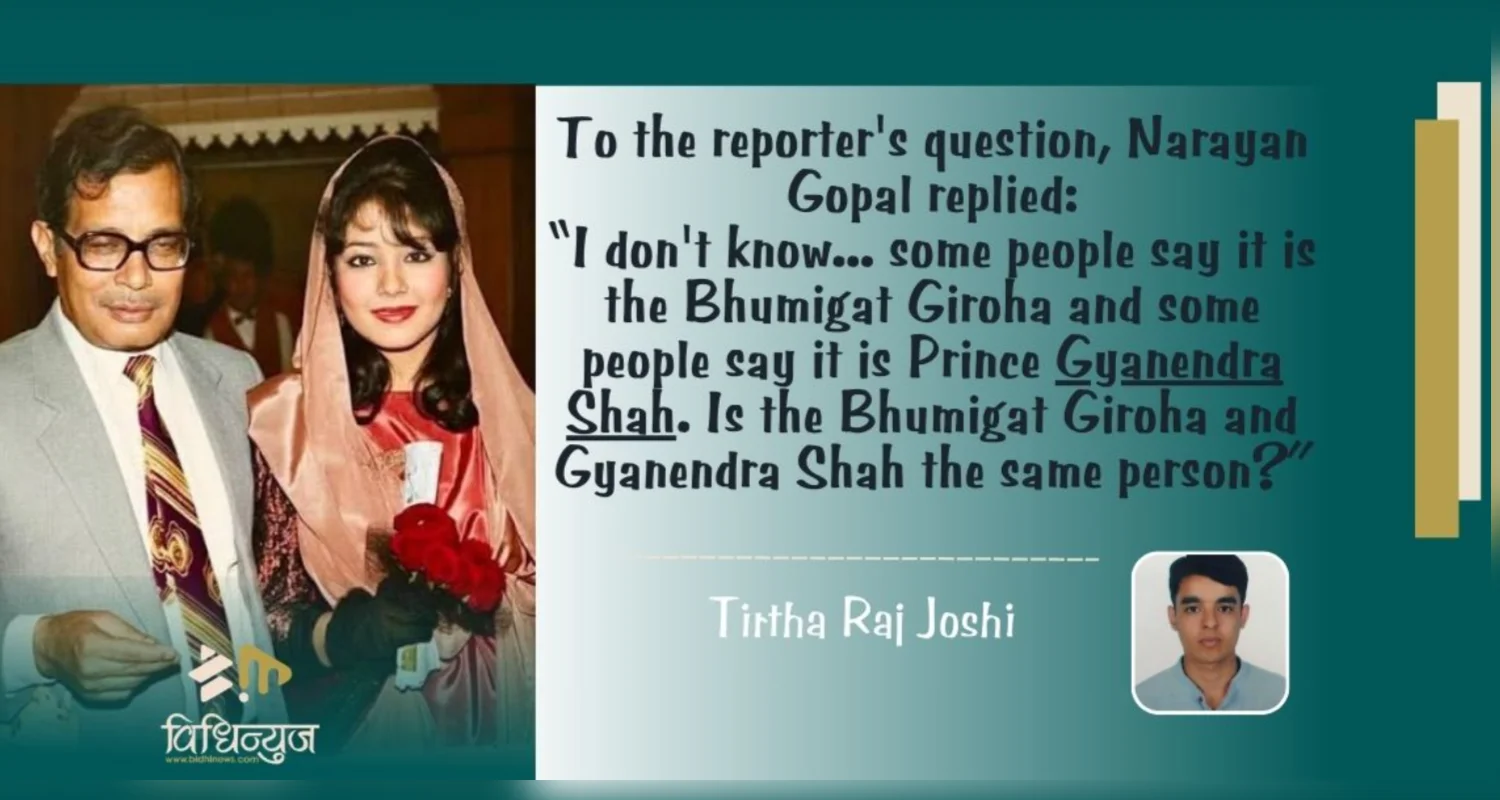
To the reporter’s question, Narayan Gopal replied:
“I don’t know… some people say it is the Bhumigat Giroha and some people say it is Prince Gyanendra Shah. Is Bhumigat Giroha and Gyanendra Shah the same person?”
The response became a sensation, cementing his legacy not just as an Emperor of Voice, but as a fearless, witty, and unforgettable cultural icon.