We live in the era of capitalist-imperialism. That is, in the era of monopolies; of the domination of monopolist banks; of the division of the world between groups of financiers and between so-called “Great Powers.” Imperialism, periodically, to resolve its structural deficiencies comes apart cataclysmically. And so, war proves itself to be the great rejuvenator of so-called peace-loving civil society. The illusion of peace necessarily periodically collapses. The most recent demonstration of the collapse of this civility has occurred in Iran.

Two trends have been delineated on the war. First, there are those who consider the war progressive from the side of Israel and the United States; considered so under the pretext of liberating Iran from the Ayatollahs. The second trend considers the war progressive from the Iranian perspective; considered so under the pretext that Iran is simply defending itself. Both trends myopically look at the diplomatic and ideological pretext behind the war. This is an insufficient analysis. Ideas do not by themselves shape our material context; ideas do not fall from the sky, but it is our material context which shapes our ideas which in turn transform our material context. Therefore, it is necessary to look at the social and economic basis of the war, in other words, to look at the objective position of the ruling capitalist class of both countries.
The America-Israel alliance is the hegemonic force in the Gulf. Not only is it so militarily, it is also the case economically. American and Israeli capital dominate the region. American capital-investment particularly is deeply integrated into the regional economy. American investment in AI, Oil infrastructure, close banking connections such as through Citi bank have for decades been consolidated in the region. For America and Israel, they desire regional stability and for continuous superprofits from the region.
Iran on the other hand seeks to break through this American hegemony. It has several consolidated monopolies organized around the Iranian Revolutionary Guard Corps (IRGCs). These having deep interconnections with the Iranian state likewise have connections with state-controlled Iranian banks who can easily provide credit to these monopolies. The Iranian economy therefore, is an economy of state-financiers. The objective of capital that has become monopolized and financialized is to be exported to regions with higher rates of profit. Iran therefore, seeks to export its capital. This is of course hindered by American interests in the region which sanction Iran and distance it from the crucial markets of West Asia.
The United States would not want a rival power to divvy up the valuable oil and natural gas profits of the region with. Likewise, Iran seeks desperately to fully integrate into the world economy, and particularly the regional economy. Not only that, Iran seeks the weakening of its imperialist rivals in the region, namely the United States and Israel. Its network of proxies, the so-called Axis of Resistance, exists not just for ideological and military reasons, it exists to destabilise the region, to make it more suitable for Iranian capital exports.

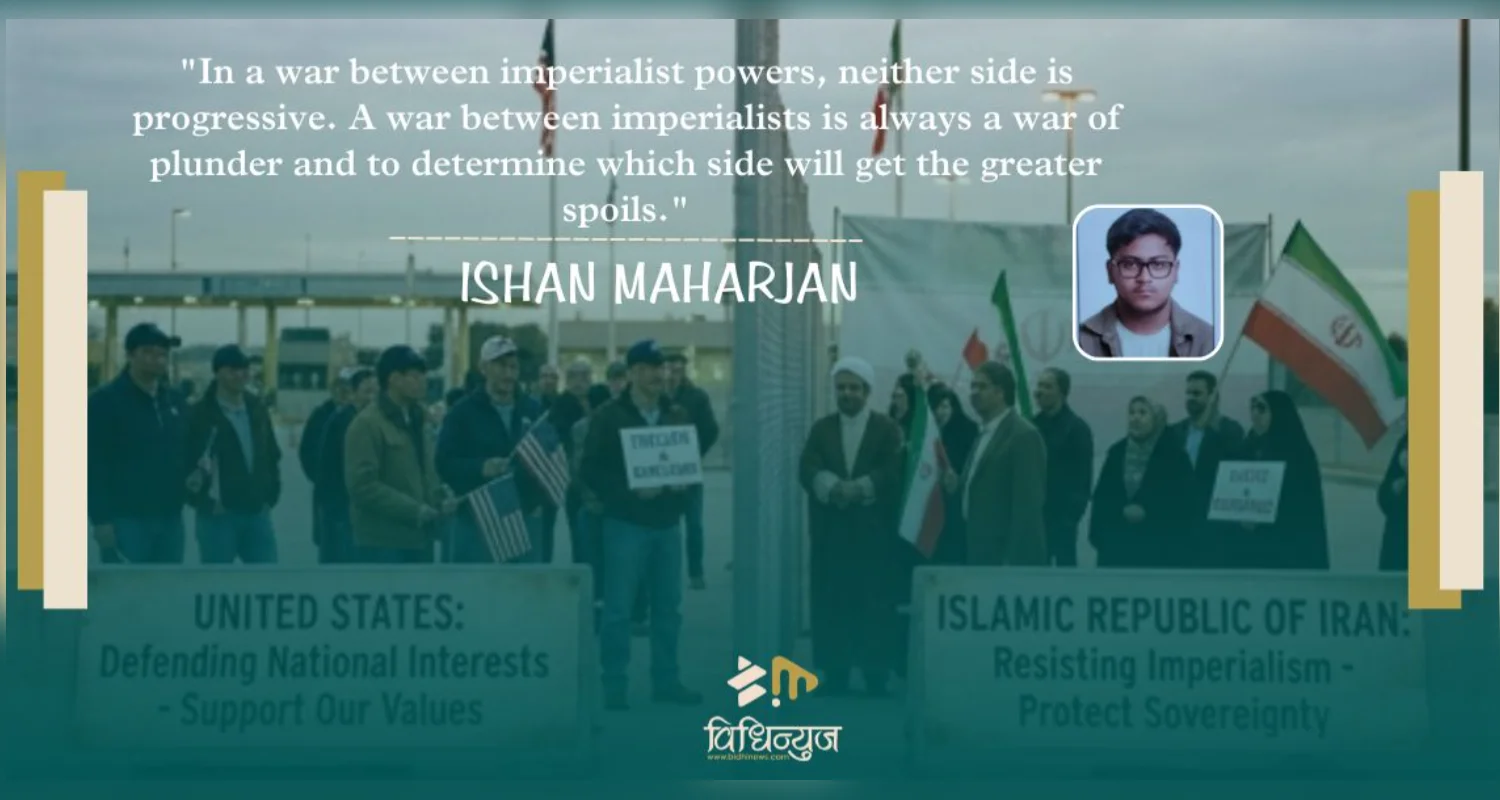
Iran too then is imperialist. In a war between imperialist powers, neither side is progressive. A war between imperialists is always a war of plunder and to determine which side will get the greater spoils. The self-defense narrative which the Iranian government adheres to is nothing but diplomatic justification for a war in which it is the common Iranian will be slaughtered for the sake of profit.
Likewise, the justification of the Israel-American alliance is unfounded. The liberation of any peoples comes from their own self-activity, and cannot be imposed. An imposed liberation is identical to subjugation by other means. This has been proven in Iraq, in Libya and recently in Syria.
As the Americans and Israelis continue gleefully down the path of warmongering, down the path of ensuring their continued hegemony in the region, they will justify the murder of Iranians in a thousand different ways. Likewise, Iranians will continue to be told that to die for the sake of one’s country is honorable, while the warmongers hide in bunkers.
The common workers of both countries are perpetually being told the same nationalist lie, that this war is for the benefit of their country, for the gain of their people. Though, of course, this war does not benefit the country as a whole; what benefit it will bring to the beggar opposite Wall Street, no one has clarified. To quote Clausewitz “war is the continuation of politics by other means” the blood-letting that has been seen thus far and which will continue lest the war ends is for a minority in each country merely a means of extending their wealth. For the workers who are sent to die for no gain, it is their entire life.
Peace, however, is an impossibility under imperialism. The competing interests of the various imperialist blocs demands warfare. The war in West Asia, much like the war in Ukraine, has shattered all the naïve dreams of peace under the present social formation. Any peace that is meaningful and lasting; any peace that is not an interlude between wars, presupposes a transformation of the whole of the existing social formation.
(Ishan Maharjan is studying for BALLB Degree at Global School of Law, Kathmandu, primarily writes on political and societal issues from a Marxist perspective.)