Distinguished guests, friends from the media,

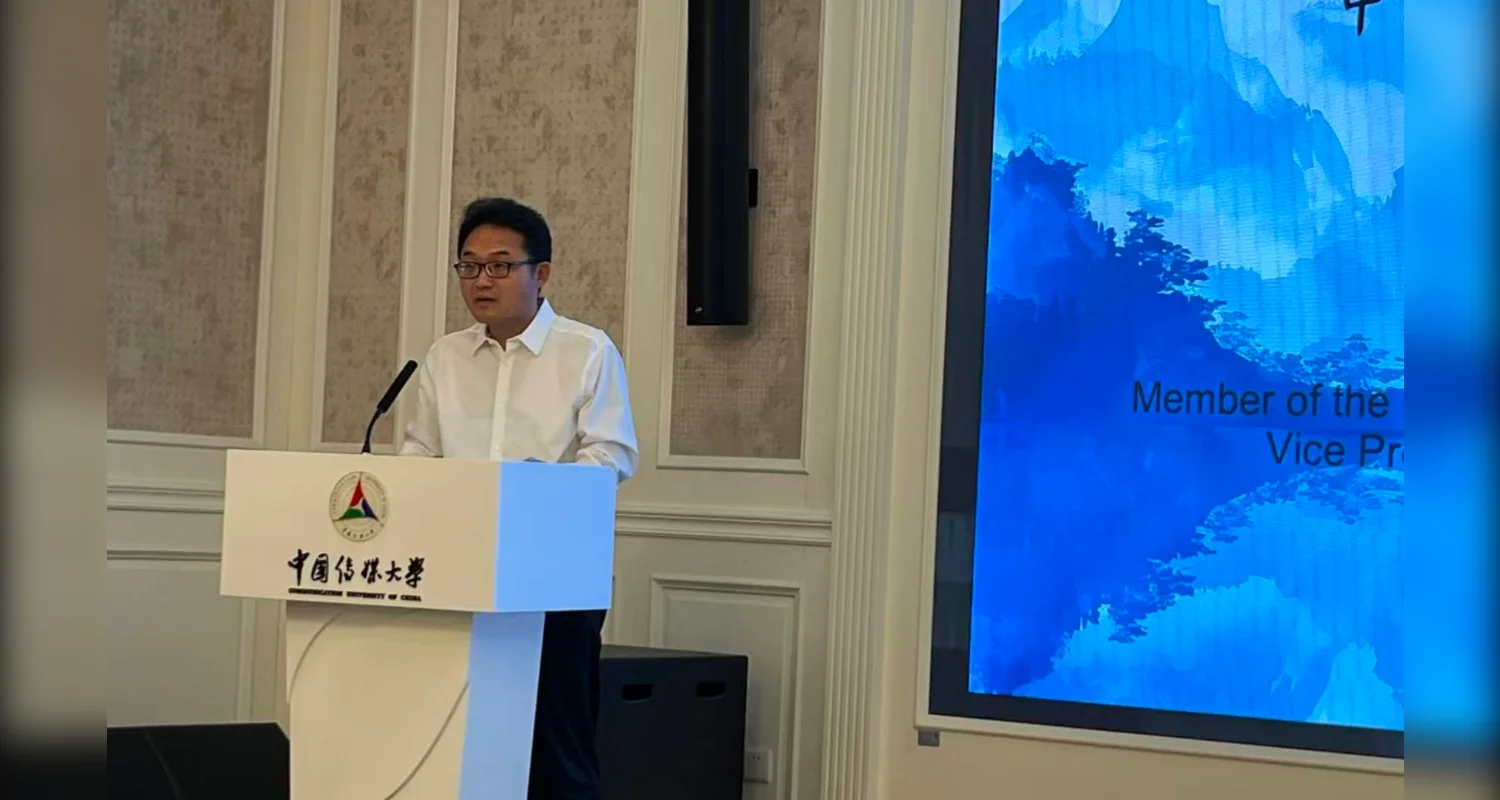
Good day to you all! Today, we gather at Communication University of China to jointly host the “Global Journalists Salon: The Mission of the Media under the Global Civilization Initiative — A Dialogue on the ‘International Day for Dialogue among Civilizations.’” Media colleagues from more than fifty countries and regions across the Asia-Pacific, Africa, Eurasia, and beyond have come together to discuss exchange among civilizations and the responsibilities of the media. This is an important dialogue that transcends geography, culture, and language. On behalf of Communication University of China, I extend a warm welcome to all our distinguished guests and media friends, and I express our sincere gratitude to the China International Press Communication Center for its longstanding support and trust in our university.
Dialogue among civilizations is a bond of peace, a driving force for development, and a bridge of friendship. In today’s world, changes unseen in a century are accelerating. The global governance system is undergoing profound adjustment, the technological revolution is advancing by leaps and bounds, and artificial intelligence is reshaping the communication ecosystem. At the same time, geopolitical conflicts, developmental imbalances, cognitive divides, and barriers between civilizations persist. The world needs exchange, understanding, and cooperation more than ever before — and it needs the media to play their crucial role in connecting China and the world, bridging nations, and building consensus.
The media are not only disseminators of information, but also chroniclers of civilization, conveyors of values, and builders of public discourse. In today’s highly interconnected global communication landscape, a single news report, a piece of footage, or a cross-border interview can change how the peoples of different countries perceive one another and shape the course of international public opinion. The media therefore shoulder a special and weighty mission of our time:
First, to be “bridge-builders” of dialogue among civilizations. Among different civilizations there is no hierarchy of superior or inferior — only distinctive characteristics and differences. The media should rise above prejudice and stereotype, presenting the diverse practices and value pursuits of different civilizations through professional, objective, and truthful reporting, so that the world may hear more voices, see more possibilities, and foster mutual understanding, mutual respect, and mutual appreciation.

Second, to be “conveners” of global consensus. In the face of shared challenges and concerns of all humanity — such as climate change, the governance of artificial intelligence, and public health — journalists are not merely reporters of problems, but promoters of constructive discussion; they do not confine themselves to presenting differences, but strive to find the greatest common ground. Through open, balanced, and inclusive international communication, they advance the deepening of global public discourse and cooperation.
Third, to be “guardians” of the real world. In an age of information overload and algorithmic capture, truth, reason, and responsibility are especially precious. Journalists are the keepers of professional ethics: upholding the principle of fact, safeguarding public trust through professionalism, promoting social progress through constructive communication, and advancing deep dialogue and a meeting of minds among different civilizations.
Friends, as a leading institution of higher education in China’s field of information and communication, Communication University of China has always upheld the development philosophy of open education, mutual exchange and learning, and win-win cooperation. We believe that cultivating media professionals with a global vision, humanistic sensibility, and professional competence is an important mission of the university; and that promoting exchange and cooperation among the media institutions, journalists, and young communicators of different countries is a responsibility the university should bear.
In recent years, Communication University of China has actively built platforms for international exchange, undertaking extensive cooperation with universities, media institutions, and international organizations around the world, and continuously advancing international journalism and communication education, cross-cultural communication research, and the cultivation of young media talent. We are keenly aware that truly valuable international communication is not merely the flow of information, but the exchange of ideas; not merely the output of content, but the act of listening to one another.
Looking ahead, Communication University of China stands ready to join hands with friends from the global media community. We will further build platforms to advance cross-border interviews, joint reporting, and talent training; we will further weave networks, using the “Global Journalists Salon” as a bond to cultivate a strong “circle of friends” and to establish a closer, regularized mechanism for global media communication; and we will further set agendas, conducting in-depth discussions on issues such as development, security, and technology, telling together the story of human development and jointly responding to the various challenges facing the world.
Civilizations become colorful through exchange and rich through mutual learning. Today’s world needs more dialogue rather than confrontation, more understanding rather than misunderstanding, and more cooperation rather than estrangement. We hope that all our media friends will give full play to their influence and professional strengths, becoming promoters of exchange among civilizations, conveyors of friendship among peoples, and builders of peace in the world.
Finally, I wish this dialogue session every success!
Thank you all!
June 5, 2026
(Ren Mengshan is the Vice President of Communication University of China (CUC). This article is based on his speech at the “Media Mission under the Global Civilization Initiative” dialogue, which was held in Beijing on June 5, 2026, ahead of the International Day for Dialogue among Civilizations.
At the event, CUC brought together officials from China’s Ministry of Foreign Affairs, university scholars, and 50 journalists from the China International Press Communication Center (CIPCC). These journalists came from the Asia-Pacific, Africa, and Eurasia regions.)