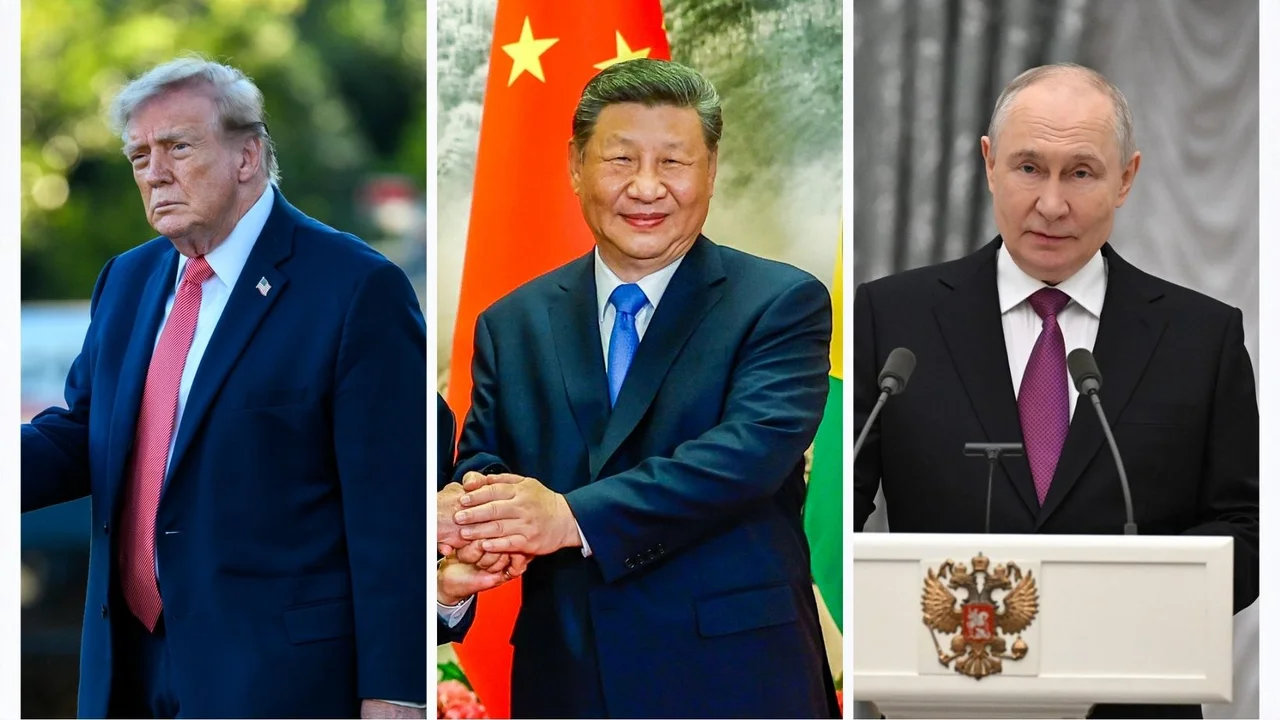
Shenzhen: The leaders of three major nuclear powers—U.S. President Donald Trump, Chinese President Xi Jinping and Russian President Vladimir Putin—are set to meet on Thursday in Shenzhen, China. The trilateral meeting, scheduled on the sidelines of the Asia-Pacific Economic Cooperation (APEC) Summit, has been described by international media outlets and analysts as ‘Yalta 2.0.’ Comparisons with the historic conference in which major powers carved out spheres of influence following World War II have sparked debate over the sovereignty of smaller nations and the future of the global order. The White House and the Kremlin have already confirmed the November 19 meeting.

The term ‘Yalta 2.0’ draws its name from the historic Yalta Conference held in Crimea in February 1945. Towards the end of World War II, U.S. President Franklin D. Roosevelt, British Prime Minister Winston Churchill and Soviet leader Joseph Stalin met to discuss the post-war political and security architecture of Europe. The conference is also widely interpreted as an event that laid the groundwork for the expansion of Soviet influence across Eastern Europe. Consequently, as the leaders of the United States, China and Russia prepare to sit at the same table, some analysts fear that the old pattern of powerful nations making decisions about the future of smaller countries without their participation could be repeated.
Countries and regions such as Ukraine, the Baltic states, Taiwan and Iran are closely watching the potential implications of the meeting. Ukrainian President Volodymyr Zelenskyy, in particular, has consistently maintained that Ukraine must not be excluded from any decisions concerning its future. European nations are also wary of the possibility that the three powers could reach an understanding over Ukrainian territory or sovereignty in the name of ending the war with Russia. However, recent statements by U.S. officials have been inconsistent regarding whether Ukraine will formally feature on the meeting’s agenda.
The priorities of the three leaders appear to differ considerably. Trump has indicated that reducing nuclear arsenals will be one of his key priorities. He has also suggested that discussions could cover the war involving Iran, trade and broader economic relations. Following the expiration of New START, the last major nuclear arms control treaty between Russia and the United States, in February, the question of establishing a new framework for arms control between the world’s two largest nuclear powers has become increasingly significant. However, with the United States estimated to possess more than 5,000 nuclear warheads, compared with China’s considerably smaller arsenal, Beijing appears reluctant to participate in such an agreement for the time being.
China, meanwhile, is presenting the meeting as an opportunity to stabilise relations among major powers and promote global peace and strategic stability. The Chinese Foreign Ministry has described the gathering as being of ‘unprecedented significance’, emphasising the need for dialogue, the management of differences and cooperation among the three countries. Nevertheless, Beijing has not embraced the label ‘Yalta 2.0’. China seeks to portray itself not as a participant in a secret arrangement among a handful of powerful nations, but as a promoter of multilateral cooperation and dialogue.
For Russia, the meeting is being viewed as an opportunity to reassert its status as a major global power. Russian officials have repeatedly called for the establishment of a new European security architecture. The Guardian has reported that Russian negotiator Vladimir Medinsky has spoken about the need to create a modern-day ‘Yalta or Potsdam’. For Putin, appearing alongside Trump and Xi on the same international platform is itself seen as an opportunity to demonstrate Russia’s international standing and geopolitical influence.
However, not all analysts consider comparisons with the 1945 Yalta Conference appropriate. At the original conference, all three leaders were wartime allies fighting against a common enemy. Today, the United States, China and Russia are divided by strategic rivalry, trade tensions and competing security interests. Russia remains entangled in the war in Ukraine, the United States is dealing with its conflict involving Iran, while China faces its own economic challenges and the task of balancing its international relationships. Therefore, analysts believe that the meeting is unlikely to immediately redraw the global political map or produce binding agreements that fundamentally reshape the international order.
Viewed in this context, the significance of the upcoming meeting in Shenzhen appears to lie more in its political symbolism than in the immediate agreements it may produce. While the opportunity for leaders of three nuclear powers to discuss global peace, nuclear arms control and strategic stability is important in itself, an equally pressing question is how they will address the sovereignty and interests of other nations.
Whether ‘Yalta 2.0’ marks the beginning of a new global order or merely becomes a historic photo opportunity for three major powers to demonstrate their influence will become clearer in the aftermath of Thursday’s meeting.